Beyond the Trend Cycle: 12 Interior Design Shifts Defining the Most Thoughtful Homes of 2026
For several years, social media made it possible for one recognizable look to spread across thousands of homes almost overnight: white oak, cream upholstery, arched mirrors, fluted panels, matte black fixtures, greige walls and carefully restrained styling. Beautiful as many of those spaces were, repetition eventually made even good design feel predictable.
In 2026, the more interesting shift is not toward one replacement style. It is toward individuality, permanence, sensory experience and better architectural thinking.
Current industry research points in the same general direction. Houzz describes homeowners as increasingly prioritizing warmth, longevity, well-being and spaces designed around real life rather than novelty. Its 2026 search data also shows growing interest in tactile materials, nostalgic references and highly personal spaces. Architectural Digest’s professional forecast similarly identifies a movement toward craftsmanship, decorative detail, customization and interiors that feel distinctly personal rather than formulaic.
But the best way to understand 2026 design is not as a checklist of things that are suddenly “in.”
It is a change in how rooms are being composed.
Here are 12 design directions that reveal where sophisticated residential interiors are actually heading.
1. The Perfectly Coordinated Room Is Giving Way to the Deliberately Collected Room
One of the most important design shifts of 2026 is subtle: rooms are becoming less coordinated.
That does not mean chaotic.
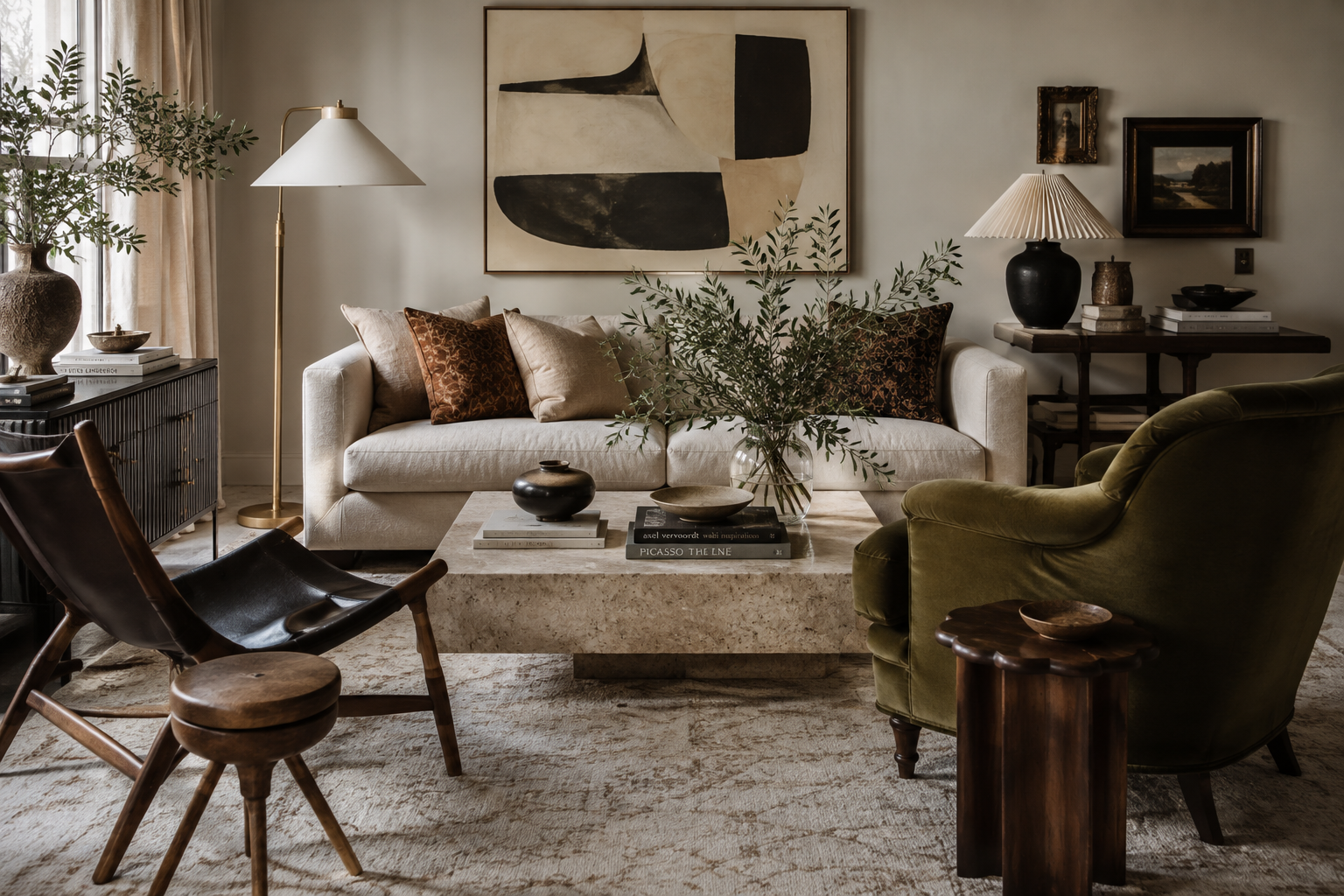
It means the sofa no longer needs to belong to the same visual family as the chairs. Every metal finish does not have to match. Side tables can be different. Vintage pieces can sit beside contemporary furniture. A sculptural object discovered while traveling might be more valuable to the composition than another perfectly coordinated accessory.
The goal is to make a room feel as though it developed over time rather than arrived on a delivery truck in one afternoon.
This collected approach is one reason patinated materials, antiques, vintage furnishings and objects with visible age are gaining renewed appreciation. Designers are increasingly embracing woods, leather, bronze, brass and other materials that become more beautiful through use.
How to apply it
Start with one controlled architectural language, then allow the furnishings to become more expressive.
For example:
- contemporary sofa
- 1970s-inspired lounge chair
- sculptural stone side table
- dark wood console
- handmade ceramic vessel
- modern artwork
- aged metal lighting
The room still feels cohesive because proportion, color and material relationships have been considered.
Cohesion does not require duplication.
That distinction will define many of the strongest interiors of the next several years.
2. Warm Neutrals Are Becoming More Complex
Beige never really disappeared.
What is disappearing is flat beige.
The new neutral interior uses undertones and material variation to create depth.
Instead of one cream repeated across every wall and textile, designers are creating what might be called tonal landscapes:
oatmeal, mushroom, camel, clay, parchment, walnut, tobacco, putty, sand, soft espresso and muted olive can coexist within the same room.
These colors may all technically be neutral, yet together they produce a surprisingly rich interior.
The larger 2026 palette also shows a willingness to introduce stronger hues. Pinterest’s 2026 palette, for example, includes Jade, Plum Noir, Persimmon, Wasabi and Cool Blue, reflecting broader interest in more expressive color.
The lesson is not that every homeowner suddenly needs a plum living room.
It is that neutral spaces are no longer expected to be colorless spaces.
Designer technique: the 70/20/10 tonal formula
Try dividing your visual palette roughly into:
70% architectural neutral
Walls, large upholstery, flooring.
20% grounding tone
Wood, stone, cabinetry or darker textiles.
10% disruptive color
Artwork, an accent chair, flowers, glass, pillows or a sculptural object.
The final 10% is often what prevents a beautiful neutral room from becoming forgettable.
3. Texture Is Becoming Architectural
Texture used to be added near the end of a project.
A boucle chair. A woven pillow. A chunky throw.
In more sophisticated 2026 interiors, texture is being considered much earlier — sometimes at the architectural stage.
We are seeing greater interest in:
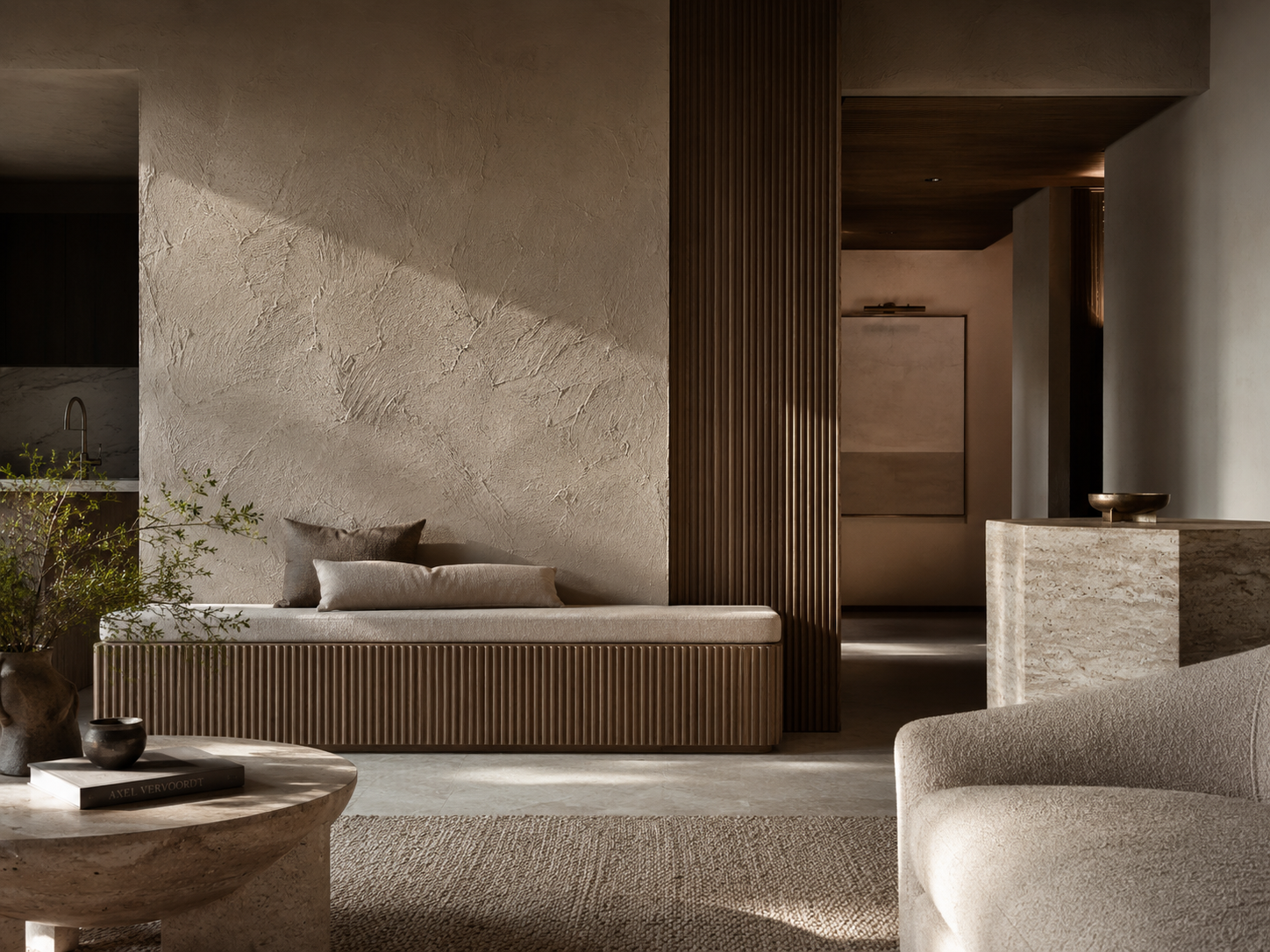
limewash-like finishes, tactile stone, irregular tile, woven wallcoverings, fluted glass, ribbed wood, textured plaster, grasscloth, brushed metal and deeply grained wood.
Houzz’s 2026 summer trend analysis showed rising interest in tactile surfaces such as sandstone walls and seagrass wallcoverings, while its data also recorded major growth in searches for scalloped and wave-patterned tile.
Why this matters
Texture affects a room before furniture does.
A softly textured wall changes the way sunlight moves across a space.
A honed stone counter absorbs light differently from a glossy quartz surface.
Reeded glass creates privacy while allowing silhouettes and light through.
Wood grain introduces movement without introducing another color.
The most successful rooms in 2026 often look simple in photographs but feel exceptionally detailed in person.
That is sensory minimalism: fewer objects, richer surfaces.
4. Curves Are Moving Out of Furniture and Into Architecture
Curved sofas have been popular for several years.
The more interesting development is that curves are migrating into the building itself.
Houzz’s 2026 search analysis found increased interest in scalloped and wave-like architectural details, suggesting that the appetite for softer geometry is expanding beyond furnishings.
Expect to see more:
arched transitions, radius corners, curved kitchen islands, softened soffits, rounded fireplace surrounds, wave-profile tile, pill-shaped mirrors and gently curved custom millwork.
The difference between this movement and the earlier “arch trend” is subtle.
A few years ago, an arch was often added because arches were fashionable.
Now designers are using curvature to control movement and visually soften rigid architecture.
A curved island can improve circulation.
A rounded wall can lead the eye toward another room.
A radius ceiling detail can distinguish zones without physically dividing them.
Curves are becoming functional geometry rather than decoration.
5. Kitchens Are Beginning to Look Less Like Kitchens
For years the luxury kitchen became increasingly recognizable:
large island, dramatic stone, statement pendants, rows of cabinetry.
Now designers are trying to make kitchens visually quieter.
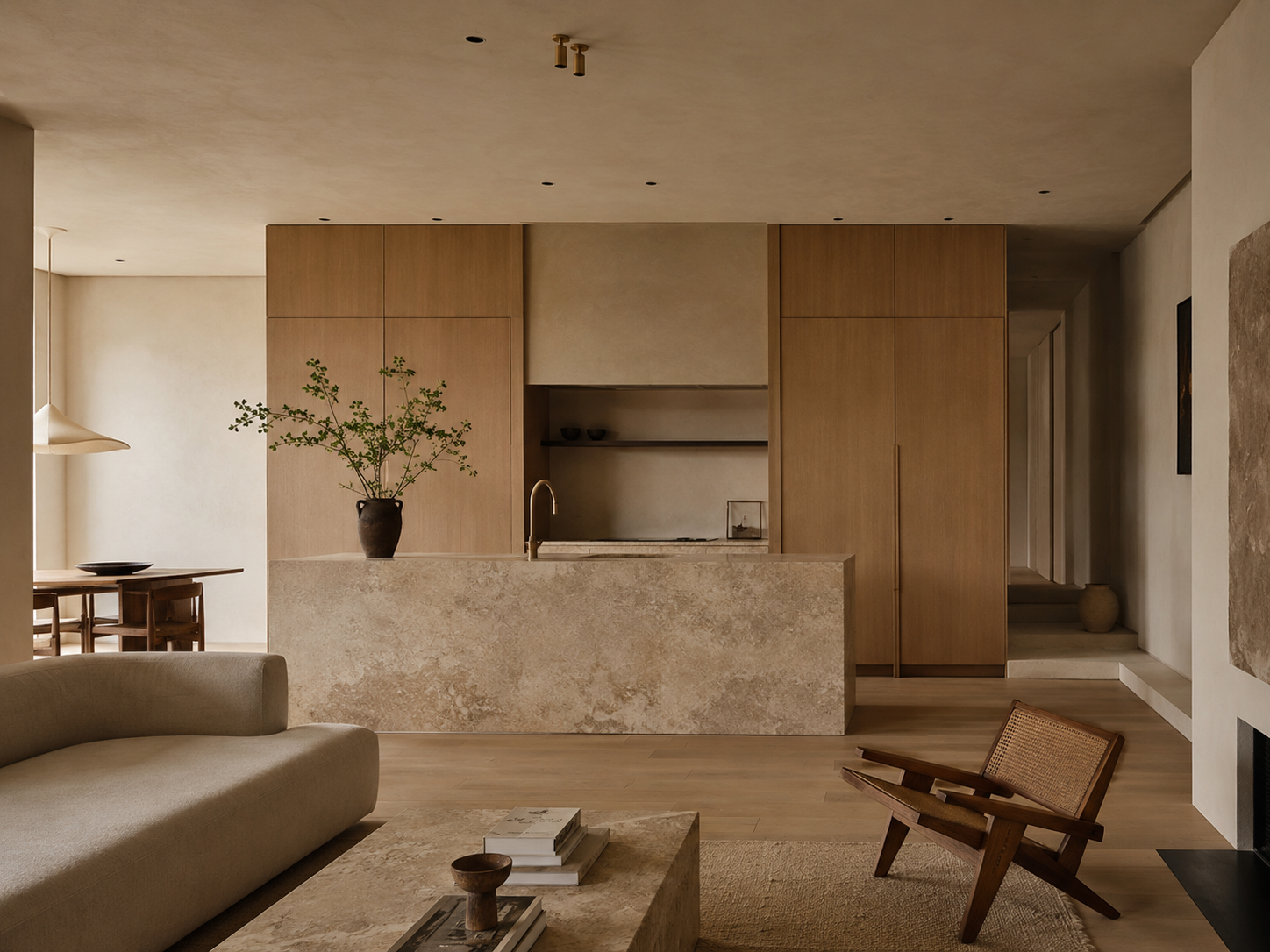
One important 2026 direction is the architectural kitchen — a kitchen whose utility disappears into the room.
Flat-panel cabinetry remains a major direction in Houzz’s 2026 design predictions.
But the broader idea extends further:
appliance garages conceal small appliances.
Panel-ready refrigerators disappear into cabinetry.
Ventilation becomes integrated.
Coffee stations live behind retractable doors.
Outlets become less visible.
Tall cabinetry is treated almost like wall paneling.
Cooktops become visually quieter.
The result is a kitchen that feels more like architecture and less like equipment.
The new luxury kitchen question
Instead of asking:
“What statement should the kitchen make?”
Designers are increasingly asking:
“What can disappear?”
That is a much more sophisticated design question.
6. Lighting Is Becoming Jewelry — While the Technology Disappears
Recessed lighting is useful.
It should not be responsible for the entire emotional experience of a room.
The best 2026 lighting plans are layered.
They combine:
architectural lighting, indirect LED, picture lights, pendants, sconces, table lamps, floor lamps and illuminated millwork.
At the decorative end of the spectrum, materials including aged brass, bronze, glass, alabaster, travertine and other natural stones are continuing to gain attention.
But an equally important trend is happening behind the fixture: better lighting technology is becoming less visible.
LED strips disappear into shelves.
Channels are recessed into millwork.
Light washes walls rather than exposing bulbs.
Toe kicks glow softly.
Vanities appear to float.
Stone niches become illuminated planes.
The 2026 lighting rule
See the effect before you see the source.
That single principle can make relatively inexpensive architecture feel dramatically more considered.
7. The Fifth Wall Is Becoming Part of the Design Again
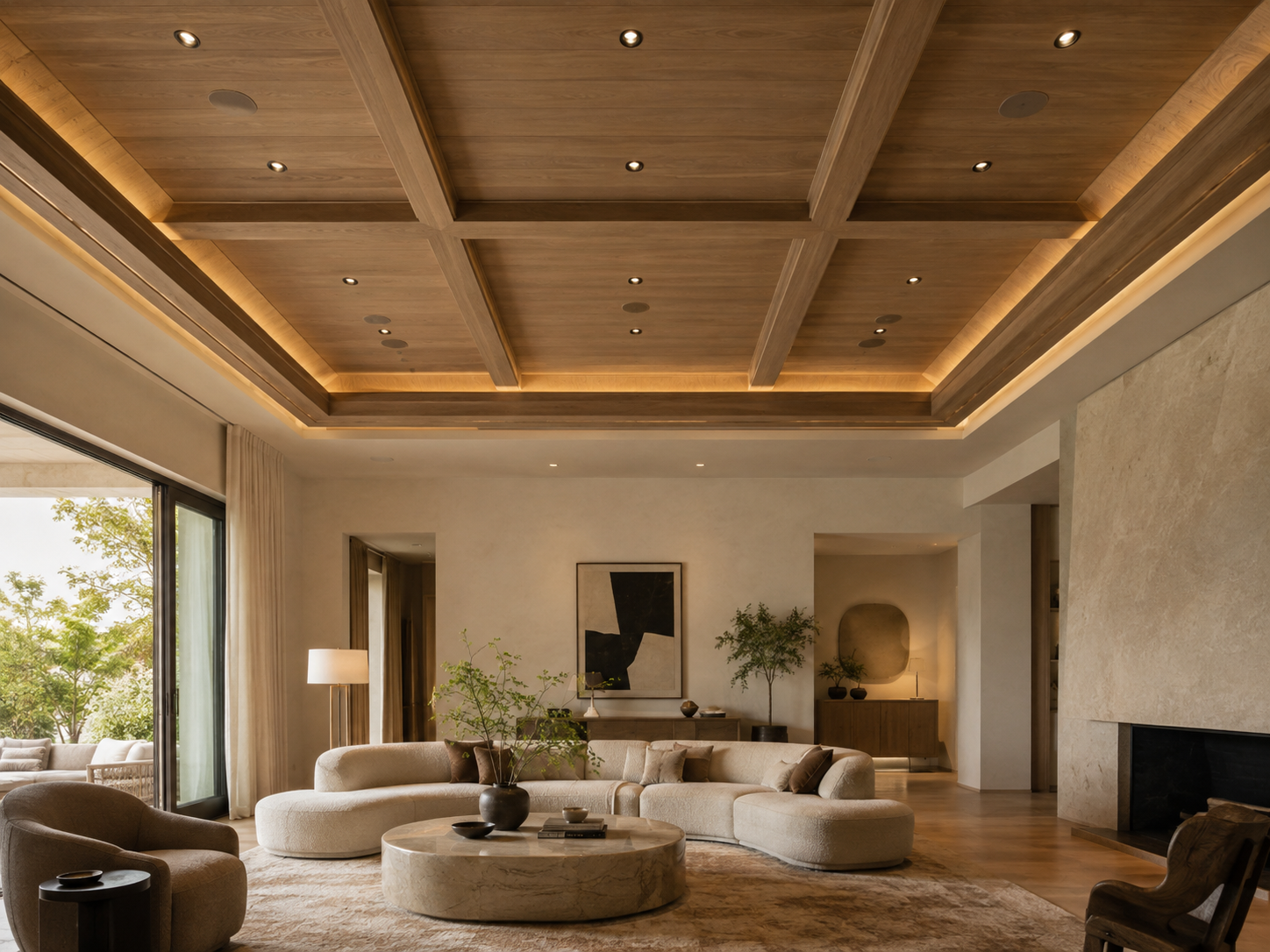
For many homes, the ceiling has spent the last decade painted white and ignored.
That is changing.
Not every ceiling needs dramatic wallpaper or elaborate millwork. But designers are increasingly recognizing that a ceiling affects proportion, intimacy and architectural character.
Depending on the home, this might mean:
wood cladding, perimeter lighting, shallow coffers, beams, tonal paint, plaster texture, wallpaper or a carefully designed recessed lighting composition.
The strongest ceiling treatments are rarely random.
They help define a zone.
Imagine an open-plan residence in which the living room ceiling is wrapped in warm wood while the adjoining kitchen remains lighter.
No wall was built.
Yet psychologically, the rooms feel distinct.
That is architectural zoning through materials.
8. Statement Stone Is Becoming More Strategic
Large-format stone and porcelain slabs remain important, but the use of them is maturing.
Natural stone with subtle drama continues to feature prominently in 2026 kitchen and bath forecasts.
The next phase is less about covering every visible surface in dramatic veining and more about choosing the exact place where stone should command attention.
A beautifully veined slab might appear only:
behind a sculptural vanity,
inside a shower,
around a fireplace,
on an island,
or as a single architectural wall.
Adjacent surfaces may intentionally become quieter.
This creates visual hierarchy.
If everything is dramatic, nothing is dramatic.
Luxury increasingly comes from restraint.
9. Wellness Design Is Moving Beyond the Spa Bathroom
“Wellness” became one of the most overused words in residential design.
In 2026, its meaning is becoming more practical.
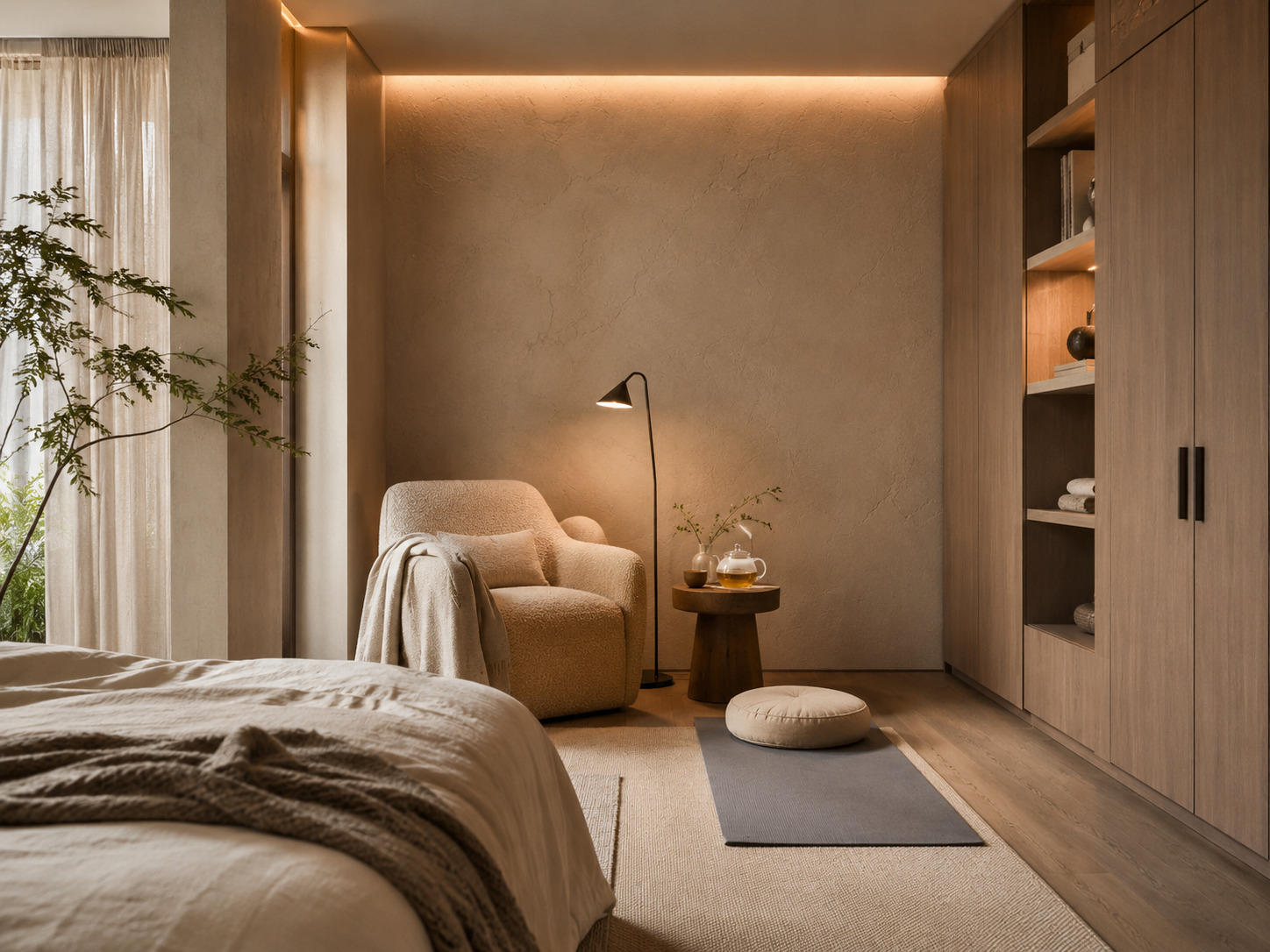
Architectural Digest’s professional forecast points to homeowners creating highly personalized wellness spaces, including exercise studios, meditation rooms and extensive bathing environments.
But wellness-focused design does not require a dedicated Pilates room.
It can mean:
better nighttime lighting,
improved acoustic privacy,
organized entry storage,
a bedroom free of visible electronics,
a small morning coffee station,
a comfortable reading corner,
tunable lighting,
a bathroom designed around actual routines,
or cabinetry that eliminates visual clutter.
The new wellness question is remarkably simple:
What friction happens repeatedly in this person’s day, and can design remove it?
That is wellness as architecture rather than marketing.
10. Forgotten Rooms Are Being Asked to Earn Their Square Footage
Formal dining rooms that are never used.
Living rooms nobody sits in.
Oversized entry spaces with little purpose.
2026 design thinking is increasingly skeptical of what might be called ceremonial square footage.
AD’s forecast similarly points away from formal spaces that exist without meaningful daily use.
Homeowners are beginning to redesign these rooms around actual behavior.
A formal dining room might become:
a dining-library hybrid,
a cocktail room,
a work-and-dining space,
a game room,
or a flexible entertaining space.
An unused living room might become a music lounge or conversation room.
Good residential design is no longer about having every expected room.
It is about making every room worth walking into.
11. Hidden Function Is Becoming the New Status Symbol
Luxury used to be extremely visible.
In many contemporary interiors, the highest level of luxury is almost invisible.
Look closely at an exceptional room and you may find:
electrical outlets built into drawers,
hidden charging stations,
motorized shades recessed into ceiling pockets,
integrated speakers,
concealed ventilation,
LED channels routed into cabinetry,
fully integrated appliances,
flush doors,
hidden storage,
toe-kick lighting,
or service spaces positioned just beyond sight.
None of these features necessarily appear in the finished photograph.
Yet they dramatically improve the experience of living in the home.
This represents one of the most important distinctions between decorating and comprehensive interior design.
Decoration improves what you see.
Architectural interior design also improves what you never need to see.
12. Personal Narrative May Be the Most Important Trend of 2026
Pinterest’s 2026 forecasts have been notably eclectic, spanning highly specific aesthetics instead of promoting one universal look. Industry coverage describes the broader shift as one toward bold self-expression and individuality.
That may ultimately be the defining design story of the year.
Homeowners are becoming less interested in asking:
“What style is this?”
And more interested in asking:
“Does this feel like us?”
That creates more interesting interiors.
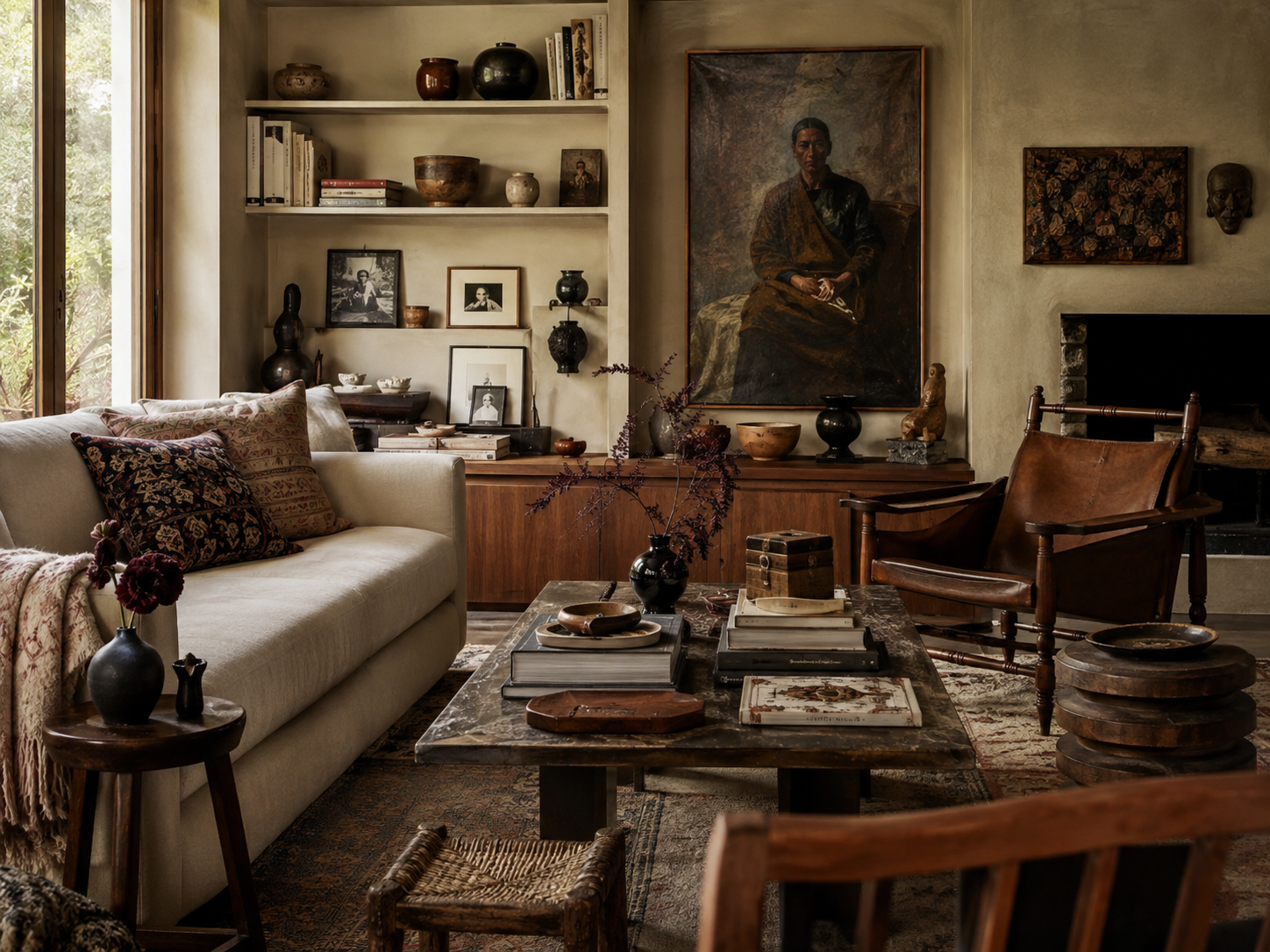
Someone can love walnut cabinetry, contemporary furniture, African sculpture, Art Deco lighting and traditional molding.
Those preferences do not need to be forced into a single design label.
A skilled designer can identify the underlying relationships — proportion, palette, material, repetition, scale — and turn apparently unrelated influences into a coherent environment.
That approach produces something trend cycles struggle to reproduce:
identity.
What Is Actually Going Out of Style in 2026?
Trends rarely disappear instantly.
More often, they become dated because they were applied so frequently that they lost context.
Rather than declaring individual materials “out,” it is more useful to recognize the design habits that are losing momentum.
The copy-and-paste luxury interior
A room assembled entirely from viral references may photograph beautifully but rarely feels personal.
Excessive matching
Matching bedroom sets, perfectly coordinated metals and identical furniture collections increasingly feel less sophisticated than thoughtfully mixed pieces.
Decorative texture without architectural purpose
Fluting, arches, slats and paneling remain useful. Applying them indiscriminately simply because they are fashionable is becoming easier to recognize.
Cold minimalism
Industry forecasts continue to point toward warmer, more tactile and expressive interiors rather than stark blank spaces.
Technology that visually dominates the room
The smarter the home becomes, the less visible its technology should ideally become.
Designing for resale before designing for life
The fear that personality will hurt resale value has created decades of unnecessarily generic interiors.
Thoughtful personalization does not require permanently eccentric construction.
Many expressive choices can live in lighting, furniture, paint, art and removable finishes.
How to Use 2026 Trends Without Making Your Home Look Dated in 2028
The most timeless way to follow a trend is to separate architecture from fashion.
Invest heavily in:
proportion, flooring, quality cabinetry, functional layouts, excellent lighting, plumbing placement, durable stone and thoughtful storage.
Experiment more freely with:
paint, wallpaper, decorative lighting, artwork, textiles, accessories, accent furniture and styling.
There is also a useful test designers can apply before committing to a trend:
Would this feature still improve the room if nobody knew it was fashionable?
If the answer is yes, it probably has longevity.
A curved wall that improves circulation has a reason to exist.
A beautiful natural stone that complements the architecture has a reason to exist.
Integrated lighting that improves nighttime ambiance has a reason to exist.
A random arch added to an otherwise rectangular room simply because arches are popular may not.
Purpose gives trends longevity.
The Bigger Interior Design Story of 2026
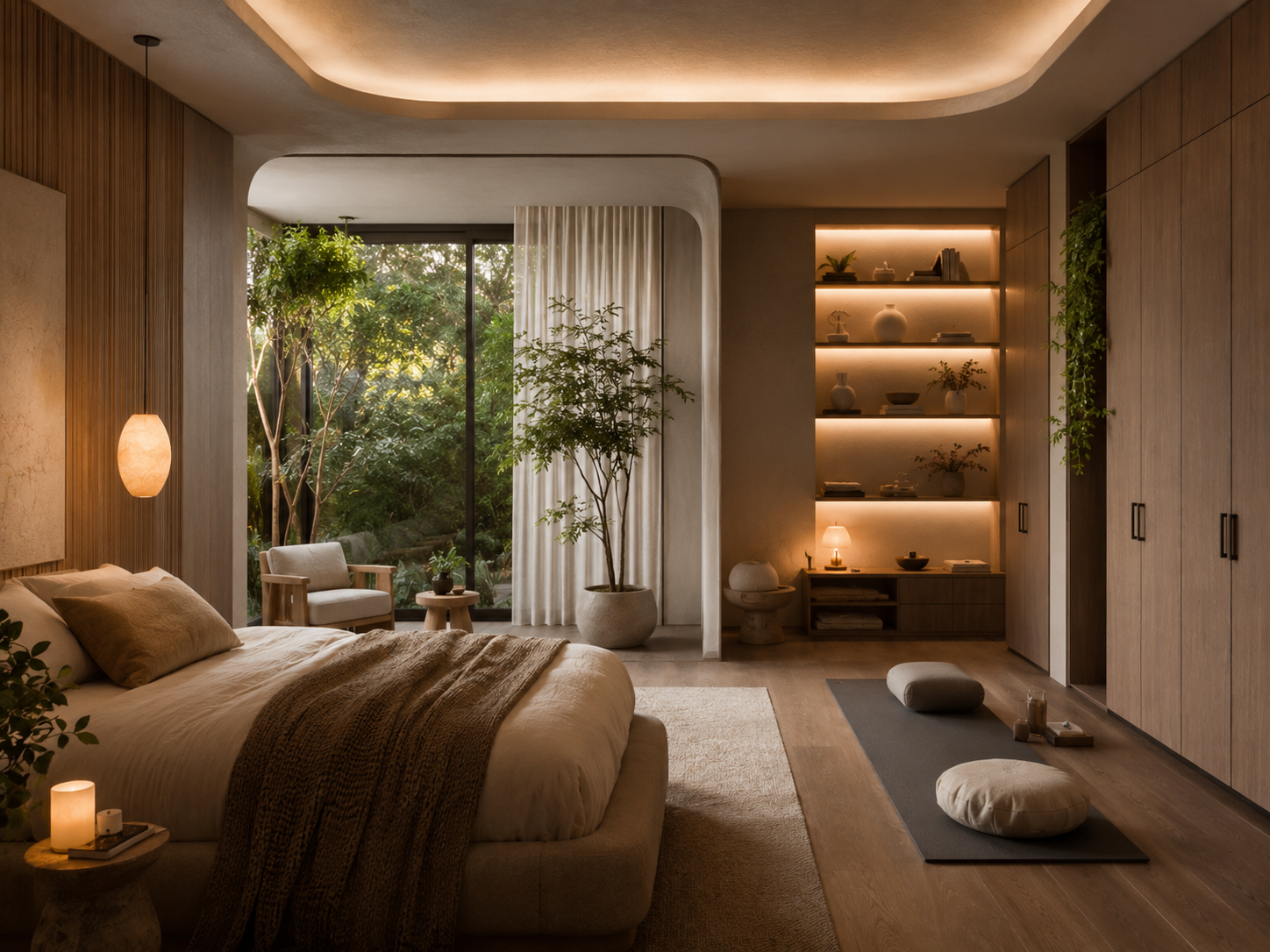
The most interesting homes of 2026 are not abandoning minimalism for maximalism or contemporary design for traditional design.
They are abandoning design by formula.
We are entering an era where sophistication comes from editing rather than copying.
Natural materials can coexist with advanced technology.
Antiques can sit beside contemporary furniture.
Minimal architecture can contain expressive art.
Warm neutrals can coexist with saturated color.
A highly luxurious room can still feel deeply comfortable.
And a home does not need to announce its design style from the doorway.
That may ultimately be the most lasting shift of 2026:
the home is becoming less of a showroom and more of a portrait of the people who live there.
When architecture, materials, lighting, furniture and personal history are allowed to work together, trends stop being instructions.
They become tools.
And that is where truly memorable interior design begins.